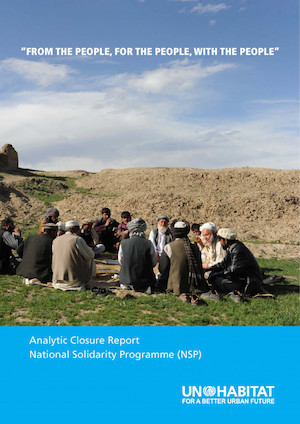
The National Solidarity Programme (NSP) was a flagship programme of the Government of Afghanistan benefiting from more than $2.3 billion of donor funding. The programme had the goal of building peace and solidarity amongst the people and to empower them to be responsible for local level governance and development.
E-Library
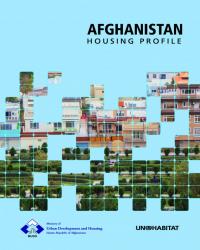
Afghanistan’s future is urban. The population of Afghan cities is expected to double within the next 15 years and by 2060, one in every two Afghans will be living in cities. This transition represents already and will continue to represent, an enormous challenge but also an opportunity for the Government, the private sector, Afghanistan’s international development partners, and, most importantly, households themselves, to deliver adequate housing for all Afghans.
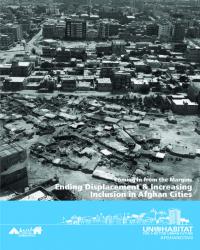
Since 2002, over 5.6 million Afghans have returned from neighbouring countries and as many as 40% of them have not been able to reintegrate in their original locations. The total number of recorded IDPs in Afghanistan is more than 1.2 million. These returnees together with IDPs, rural-urban migrants and high natural population growth have resulted in an unprecedented expansion of Afghan cities.
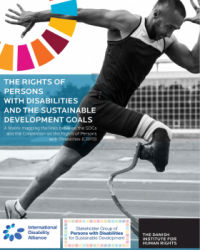
The 2030 Agenda for Sustainable Development is “grounded in [..] international human rights treaties” and is informed, among others, by the Universal Declaration of Human Rights and UN Declaration on the Right to Development. The 2030 Agenda “seeks to realize the human rights of all”. It also explicitly seeks to ensure that no one is left behind, reflecting the fundamental human rights principle of non-discrimination.
In the context of efforts to increase levels of inclusive economic growth and entrepreneurship, bringing youth into developing economies is of real importance. However, despite the large pool of talent and high entrepreneurial capacities, access to business financing remains a significant hinderance to youth financial inclusion.
Rapid advances in technology will profoundly affect societies in Asia-Pacific. The Fourth Industrial Revolution—characterised by innovations such as artificial intelligence, automation, and bio-technology—is likely to transform existing systems of production, management, and governance.
This publication was launched at the COP24 in Poland by FAO’s Deputy Director General, Ms. Maria Helena Semedo at the Global Alliance for Climate Smart Agriculture side event yesterday.
The Asia-Pacific Trade and Investment Report (APTIR) is a recurrent publication prepared by the Trade, Investment and Innovation Division of the United Nations Economic and Social Commission for Asia and the Pacific. It provides information and independent analyses of regional trends and policy developments in trade, goods and commercial services, as well as foreign direct investment.
The Asia-Pacific Sustainable Development Journal (APSDJ) is a rebranded publication issued by the Economic and Social Commission for Asia and the Pacific (ESCAP). It builds on the success of two former ESCAP Journals – the Asia-Pacific Population Journal, launched in 1986, and the Asia-Pacific Development Journal, launched in 1994.
The fifth in the series of Inequality of Opportunity in Asia and the Pacific policy papers (following Education, Decent Work, Clean Energy and Children’s Nutrition) , this paper highlights why it is important to reduce inequalities in access to clean water and basic sanitation. It also introduces new ways of analyzing surveys to measure inequality of opportunity and to identify the shared circumstances of those “furthest behind” in 22 ESCAP member States.
Afghanistan’s future is urban. The population of Afghan cities is expected to double within the next 15 years and by 2060, one in every two Afghans will be living in cities. This transition represents already and will continue to represent, an enormous challenge but also an opportunity for the Government, the private sector, Afghanistan’s international development partners, and, most importantly, households themselves, to deliver adequate housing for all Afghans.
Since 2002, over 5.6 million Afghans have returned from neighbouring countries and as many as 40% of them have not been able to reintegrate in their original locations. The total number of recorded IDPs in Afghanistan is more than 1.2 million. These returnees together with IDPs, rural-urban migrants and high natural population growth have resulted in an unprecedented expansion of Afghan cities.
The 2030 Agenda for Sustainable Development is “grounded in [..] international human rights treaties” and is informed, among others, by the Universal Declaration of Human Rights and UN Declaration on the Right to Development. The 2030 Agenda “seeks to realize the human rights of all”. It also explicitly seeks to ensure that no one is left behind, reflecting the fundamental human rights principle of non-discrimination.
In the context of efforts to increase levels of inclusive economic growth and entrepreneurship, bringing youth into developing economies is of real importance. However, despite the large pool of talent and high entrepreneurial capacities, access to business financing remains a significant hinderance to youth financial inclusion.
Rapid advances in technology will profoundly affect societies in Asia-Pacific. The Fourth Industrial Revolution—characterised by innovations such as artificial intelligence, automation, and bio-technology—is likely to transform existing systems of production, management, and governance.
This publication was launched at the COP24 in Poland by FAO’s Deputy Director General, Ms. Maria Helena Semedo at the Global Alliance for Climate Smart Agriculture side event yesterday.
The Asia-Pacific Trade and Investment Report (APTIR) is a recurrent publication prepared by the Trade, Investment and Innovation Division of the United Nations Economic and Social Commission for Asia and the Pacific. It provides information and independent analyses of regional trends and policy developments in trade, goods and commercial services, as well as foreign direct investment.
The Asia-Pacific Sustainable Development Journal (APSDJ) is a rebranded publication issued by the Economic and Social Commission for Asia and the Pacific (ESCAP). It builds on the success of two former ESCAP Journals – the Asia-Pacific Population Journal, launched in 1986, and the Asia-Pacific Development Journal, launched in 1994.
The fifth in the series of Inequality of Opportunity in Asia and the Pacific policy papers (following Education, Decent Work, Clean Energy and Children’s Nutrition) , this paper highlights why it is important to reduce inequalities in access to clean water and basic sanitation. It also introduces new ways of analyzing surveys to measure inequality of opportunity and to identify the shared circumstances of those “furthest behind” in 22 ESCAP member States.

Afghanistan’s future is urban. The population of Afghan cities is expected to double within the next 15 years and by 2060, one in every two Afghans will be living in cities. This transition represents already and will continue to represent, an enormous challenge but also an opportunity for the Government, the private sector, Afghanistan’s international development partners, and, most importantly, households themselves, to deliver adequate housing for all Afghans.
Since 2002, over 5.6 million Afghans have returned from neighbouring countries and as many as 40% of them have not been able to reintegrate in their original locations. The total number of recorded IDPs in Afghanistan is more than 1.2 million. These returnees together with IDPs, rural-urban migrants and high natural population growth have resulted in an unprecedented expansion of Afghan cities.
The 2030 Agenda for Sustainable Development is “grounded in [..] international human rights treaties” and is informed, among others, by the Universal Declaration of Human Rights and UN Declaration on the Right to Development. The 2030 Agenda “seeks to realize the human rights of all”. It also explicitly seeks to ensure that no one is left behind, reflecting the fundamental human rights principle of non-discrimination.
In the context of efforts to increase levels of inclusive economic growth and entrepreneurship, bringing youth into developing economies is of real importance. However, despite the large pool of talent and high entrepreneurial capacities, access to business financing remains a significant hinderance to youth financial inclusion.
Rapid advances in technology will profoundly affect societies in Asia-Pacific. The Fourth Industrial Revolution—characterised by innovations such as artificial intelligence, automation, and bio-technology—is likely to transform existing systems of production, management, and governance.
This publication was launched at the COP24 in Poland by FAO’s Deputy Director General, Ms. Maria Helena Semedo at the Global Alliance for Climate Smart Agriculture side event yesterday.
The Asia-Pacific Trade and Investment Report (APTIR) is a recurrent publication prepared by the Trade, Investment and Innovation Division of the United Nations Economic and Social Commission for Asia and the Pacific. It provides information and independent analyses of regional trends and policy developments in trade, goods and commercial services, as well as foreign direct investment.
The Asia-Pacific Sustainable Development Journal (APSDJ) is a rebranded publication issued by the Economic and Social Commission for Asia and the Pacific (ESCAP). It builds on the success of two former ESCAP Journals – the Asia-Pacific Population Journal, launched in 1986, and the Asia-Pacific Development Journal, launched in 1994.
The fifth in the series of Inequality of Opportunity in Asia and the Pacific policy papers (following Education, Decent Work, Clean Energy and Children’s Nutrition) , this paper highlights why it is important to reduce inequalities in access to clean water and basic sanitation. It also introduces new ways of analyzing surveys to measure inequality of opportunity and to identify the shared circumstances of those “furthest behind” in 22 ESCAP member States.

Since 2002, over 5.6 million Afghans have returned from neighbouring countries and as many as 40% of them have not been able to reintegrate in their original locations. The total number of recorded IDPs in Afghanistan is more than 1.2 million. These returnees together with IDPs, rural-urban migrants and high natural population growth have resulted in an unprecedented expansion of Afghan cities.
The 2030 Agenda for Sustainable Development is “grounded in [..] international human rights treaties” and is informed, among others, by the Universal Declaration of Human Rights and UN Declaration on the Right to Development. The 2030 Agenda “seeks to realize the human rights of all”. It also explicitly seeks to ensure that no one is left behind, reflecting the fundamental human rights principle of non-discrimination.
In the context of efforts to increase levels of inclusive economic growth and entrepreneurship, bringing youth into developing economies is of real importance. However, despite the large pool of talent and high entrepreneurial capacities, access to business financing remains a significant hinderance to youth financial inclusion.
Rapid advances in technology will profoundly affect societies in Asia-Pacific. The Fourth Industrial Revolution—characterised by innovations such as artificial intelligence, automation, and bio-technology—is likely to transform existing systems of production, management, and governance.
This publication was launched at the COP24 in Poland by FAO’s Deputy Director General, Ms. Maria Helena Semedo at the Global Alliance for Climate Smart Agriculture side event yesterday.
The Asia-Pacific Trade and Investment Report (APTIR) is a recurrent publication prepared by the Trade, Investment and Innovation Division of the United Nations Economic and Social Commission for Asia and the Pacific. It provides information and independent analyses of regional trends and policy developments in trade, goods and commercial services, as well as foreign direct investment.
The Asia-Pacific Sustainable Development Journal (APSDJ) is a rebranded publication issued by the Economic and Social Commission for Asia and the Pacific (ESCAP). It builds on the success of two former ESCAP Journals – the Asia-Pacific Population Journal, launched in 1986, and the Asia-Pacific Development Journal, launched in 1994.
The fifth in the series of Inequality of Opportunity in Asia and the Pacific policy papers (following Education, Decent Work, Clean Energy and Children’s Nutrition) , this paper highlights why it is important to reduce inequalities in access to clean water and basic sanitation. It also introduces new ways of analyzing surveys to measure inequality of opportunity and to identify the shared circumstances of those “furthest behind” in 22 ESCAP member States.

The 2030 Agenda for Sustainable Development is “grounded in [..] international human rights treaties” and is informed, among others, by the Universal Declaration of Human Rights and UN Declaration on the Right to Development. The 2030 Agenda “seeks to realize the human rights of all”. It also explicitly seeks to ensure that no one is left behind, reflecting the fundamental human rights principle of non-discrimination.
In the context of efforts to increase levels of inclusive economic growth and entrepreneurship, bringing youth into developing economies is of real importance. However, despite the large pool of talent and high entrepreneurial capacities, access to business financing remains a significant hinderance to youth financial inclusion.
Rapid advances in technology will profoundly affect societies in Asia-Pacific. The Fourth Industrial Revolution—characterised by innovations such as artificial intelligence, automation, and bio-technology—is likely to transform existing systems of production, management, and governance.
This publication was launched at the COP24 in Poland by FAO’s Deputy Director General, Ms. Maria Helena Semedo at the Global Alliance for Climate Smart Agriculture side event yesterday.
The Asia-Pacific Trade and Investment Report (APTIR) is a recurrent publication prepared by the Trade, Investment and Innovation Division of the United Nations Economic and Social Commission for Asia and the Pacific. It provides information and independent analyses of regional trends and policy developments in trade, goods and commercial services, as well as foreign direct investment.
The Asia-Pacific Sustainable Development Journal (APSDJ) is a rebranded publication issued by the Economic and Social Commission for Asia and the Pacific (ESCAP). It builds on the success of two former ESCAP Journals – the Asia-Pacific Population Journal, launched in 1986, and the Asia-Pacific Development Journal, launched in 1994.
The fifth in the series of Inequality of Opportunity in Asia and the Pacific policy papers (following Education, Decent Work, Clean Energy and Children’s Nutrition) , this paper highlights why it is important to reduce inequalities in access to clean water and basic sanitation. It also introduces new ways of analyzing surveys to measure inequality of opportunity and to identify the shared circumstances of those “furthest behind” in 22 ESCAP member States.

In the context of efforts to increase levels of inclusive economic growth and entrepreneurship, bringing youth into developing economies is of real importance. However, despite the large pool of talent and high entrepreneurial capacities, access to business financing remains a significant hinderance to youth financial inclusion.
Rapid advances in technology will profoundly affect societies in Asia-Pacific. The Fourth Industrial Revolution—characterised by innovations such as artificial intelligence, automation, and bio-technology—is likely to transform existing systems of production, management, and governance.
This publication was launched at the COP24 in Poland by FAO’s Deputy Director General, Ms. Maria Helena Semedo at the Global Alliance for Climate Smart Agriculture side event yesterday.
The Asia-Pacific Trade and Investment Report (APTIR) is a recurrent publication prepared by the Trade, Investment and Innovation Division of the United Nations Economic and Social Commission for Asia and the Pacific. It provides information and independent analyses of regional trends and policy developments in trade, goods and commercial services, as well as foreign direct investment.
The Asia-Pacific Sustainable Development Journal (APSDJ) is a rebranded publication issued by the Economic and Social Commission for Asia and the Pacific (ESCAP). It builds on the success of two former ESCAP Journals – the Asia-Pacific Population Journal, launched in 1986, and the Asia-Pacific Development Journal, launched in 1994.
The fifth in the series of Inequality of Opportunity in Asia and the Pacific policy papers (following Education, Decent Work, Clean Energy and Children’s Nutrition) , this paper highlights why it is important to reduce inequalities in access to clean water and basic sanitation. It also introduces new ways of analyzing surveys to measure inequality of opportunity and to identify the shared circumstances of those “furthest behind” in 22 ESCAP member States.

Rapid advances in technology will profoundly affect societies in Asia-Pacific. The Fourth Industrial Revolution—characterised by innovations such as artificial intelligence, automation, and bio-technology—is likely to transform existing systems of production, management, and governance.
This publication was launched at the COP24 in Poland by FAO’s Deputy Director General, Ms. Maria Helena Semedo at the Global Alliance for Climate Smart Agriculture side event yesterday.
The Asia-Pacific Trade and Investment Report (APTIR) is a recurrent publication prepared by the Trade, Investment and Innovation Division of the United Nations Economic and Social Commission for Asia and the Pacific. It provides information and independent analyses of regional trends and policy developments in trade, goods and commercial services, as well as foreign direct investment.
The Asia-Pacific Sustainable Development Journal (APSDJ) is a rebranded publication issued by the Economic and Social Commission for Asia and the Pacific (ESCAP). It builds on the success of two former ESCAP Journals – the Asia-Pacific Population Journal, launched in 1986, and the Asia-Pacific Development Journal, launched in 1994.
The fifth in the series of Inequality of Opportunity in Asia and the Pacific policy papers (following Education, Decent Work, Clean Energy and Children’s Nutrition) , this paper highlights why it is important to reduce inequalities in access to clean water and basic sanitation. It also introduces new ways of analyzing surveys to measure inequality of opportunity and to identify the shared circumstances of those “furthest behind” in 22 ESCAP member States.
This publication was launched at the COP24 in Poland by FAO’s Deputy Director General, Ms. Maria Helena Semedo at the Global Alliance for Climate Smart Agriculture side event yesterday.
The Asia-Pacific Trade and Investment Report (APTIR) is a recurrent publication prepared by the Trade, Investment and Innovation Division of the United Nations Economic and Social Commission for Asia and the Pacific. It provides information and independent analyses of regional trends and policy developments in trade, goods and commercial services, as well as foreign direct investment.
The Asia-Pacific Sustainable Development Journal (APSDJ) is a rebranded publication issued by the Economic and Social Commission for Asia and the Pacific (ESCAP). It builds on the success of two former ESCAP Journals – the Asia-Pacific Population Journal, launched in 1986, and the Asia-Pacific Development Journal, launched in 1994.
The fifth in the series of Inequality of Opportunity in Asia and the Pacific policy papers (following Education, Decent Work, Clean Energy and Children’s Nutrition) , this paper highlights why it is important to reduce inequalities in access to clean water and basic sanitation. It also introduces new ways of analyzing surveys to measure inequality of opportunity and to identify the shared circumstances of those “furthest behind” in 22 ESCAP member States.

The Asia-Pacific Trade and Investment Report (APTIR) is a recurrent publication prepared by the Trade, Investment and Innovation Division of the United Nations Economic and Social Commission for Asia and the Pacific. It provides information and independent analyses of regional trends and policy developments in trade, goods and commercial services, as well as foreign direct investment.
The Asia-Pacific Sustainable Development Journal (APSDJ) is a rebranded publication issued by the Economic and Social Commission for Asia and the Pacific (ESCAP). It builds on the success of two former ESCAP Journals – the Asia-Pacific Population Journal, launched in 1986, and the Asia-Pacific Development Journal, launched in 1994.
The fifth in the series of Inequality of Opportunity in Asia and the Pacific policy papers (following Education, Decent Work, Clean Energy and Children’s Nutrition) , this paper highlights why it is important to reduce inequalities in access to clean water and basic sanitation. It also introduces new ways of analyzing surveys to measure inequality of opportunity and to identify the shared circumstances of those “furthest behind” in 22 ESCAP member States.

The Asia-Pacific Sustainable Development Journal (APSDJ) is a rebranded publication issued by the Economic and Social Commission for Asia and the Pacific (ESCAP). It builds on the success of two former ESCAP Journals – the Asia-Pacific Population Journal, launched in 1986, and the Asia-Pacific Development Journal, launched in 1994.
The fifth in the series of Inequality of Opportunity in Asia and the Pacific policy papers (following Education, Decent Work, Clean Energy and Children’s Nutrition) , this paper highlights why it is important to reduce inequalities in access to clean water and basic sanitation. It also introduces new ways of analyzing surveys to measure inequality of opportunity and to identify the shared circumstances of those “furthest behind” in 22 ESCAP member States.

The fifth in the series of Inequality of Opportunity in Asia and the Pacific policy papers (following Education, Decent Work, Clean Energy and Children’s Nutrition) , this paper highlights why it is important to reduce inequalities in access to clean water and basic sanitation. It also introduces new ways of analyzing surveys to measure inequality of opportunity and to identify the shared circumstances of those “furthest behind” in 22 ESCAP member States.