Overview

Социальная защита основывается на всеобщем праве каждого на социальное обеспечение и уровень жизни, достаточный для здоровья и благополучия их самих и их семей. Это вытекает из принципа, согласно которому никто не должен жить ниже определенного уровня дохода, и каждый должен иметь доступ к базовым социальным услугам.
Социальная защита является мощным инструментом уменьшения неравенства и повышения устойчивости к потрясениям и кризисам в течение жизненного цикла. Он обеспечивает прочную основу для реализации экономических, социальных и экологических аспектов Повестки дня в области устойчивого развития на период до 2030 года. Поэтому социальная защита прямо упоминается в четырех Целях устойчивого развития, связанных с искоренением нищеты (ЦУР 1); обеспечением здорового образа жизни (ЦУР 3); достижением гендерного равенства (ЦУР 5); и сокращением неравенства (ЦУР 10).
В соответствии с задачей ЦУР 1.3 страны обязались внедрить надлежащие системы и меры социальной защиты для всех, включая установление минимальных уровней, и к 2030 году достичь существенного охвата бедных и уязвимых слоев населения. Национальные минимальные уровни социальной защиты (Рекомендация МОТ о социальных уровнях за 2012 год (№ 202)) должны включать как минимум следующие четыре гарантии социального обеспечения:
-
доступ к необходимой медицинской помощи, включая охрану материнства;
-
обеспечение базового дохода для детей, обеспечение доступа к питанию, образованию, уходу и любым другим необходимым товарам и услугам;
-
обеспечение базового дохода для лиц в активном возрасте, которые не могут получить достаточный доход, особенно в случаях болезни, безработицы, материнства и инвалидности;
-
обеспечение базовое дохода для пожилых людей.
Несмотря на значительный экономический и социальный прогресс в Азиатско-Тихоокеанском регионе, сохраняются серьезные пробелы в сфере социальной защиты. Например,
-
Только 21 из 49 стран предлагают пособия детям и их семьям, что способствует высокому уровню задержки роста, недоедания и детской смертности;
-
Только 1 из 5 безработных взрослых трудоспособного возраста получают пособие по безработице;
-
Только 3 из 10 матерей с новорожденными получают пособия по материнству;
-
Менее 4 из 10 человек в регионе имеют доступ к медицинской помощи;
-
Чуть более половины всех пожилых людей получают пенсию по старости, а менее одной трети рабочей силы активно участвует в пенсионной программе;
-
Менее половины всех людей с ограниченными возможностями в регионе имеют пособие по инвалидности.
Политика социальной защиты должна основываться на правовых рамках, политической приверженности и опираться на внутреннее финансирование. Программы социальной защиты в регионе часто бывают небольшими и разрозненными, с ограниченной координацией между участниками, что требует от стран перехода к общесекторальному подходу, сочетающему схемы с взносами и без взносов для целостного обеспечения охвата в течение всего жизненного цикла. Поскольку 60 процентов рабочей силы в регионе занято в неформальном секторе, финансируемая государством социальная защита остается ключевым фактором обеспечения всеобщего охвата социальной защитой.
Чтобы не оставить никого позади, программы социальной защиты должны быть всеохватными и обеспечивать адекватный уровень пособий. Универсальный подход к социальной защите, при котором льготы распространяются на всех в рамках, например, возрастной группы, является наилучшим способом охвата тех, кто находится далеко позади.
Поскольку развивающиеся страны в Азиатско-Тихоокеанском регионе расходуют лишь около 3,7 процента ВВП на социальную защиту по сравнению со средним мировым показателем в 11,2 процента, существуют также значительные возможности для увеличения инвестиций в социальную защиту для устранения пробелов в охвате в регионе.
Social Outlook for Asia and the Pacific
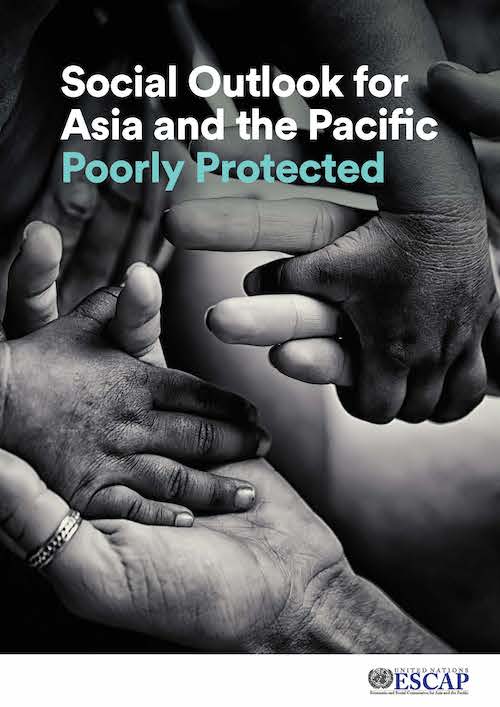
ESCAP’s flagship publication Social Outlook for Asia and the Pacific: Poorly Protected, launched at the fifth Session of the Committee on Social Development on 28 November 2018, calls on countries across Asia and the Pacific to beef up their investment in people, pointing out how greater investment in social protection can be a game changer for ending poverty.
The report shows that increasing the region’s investment in social protection to the global average could help eradicate extreme poverty in countries such as Bangladesh, India, Nepal and the Philippines. It would lift 52 million people out of extreme poverty and 328 million people out of moderate poverty. Such an investment would also lead to an increase in GDP growth and reduced income inequalities. The study cites examples of low- and lower-middle income countries that have been successful first movers in investing well in people, including Bhutan, Mongolia, Thailand and Viet Nam.
Time for Equality: the role of social protection in reducing inequalities in Asia and the Pacific
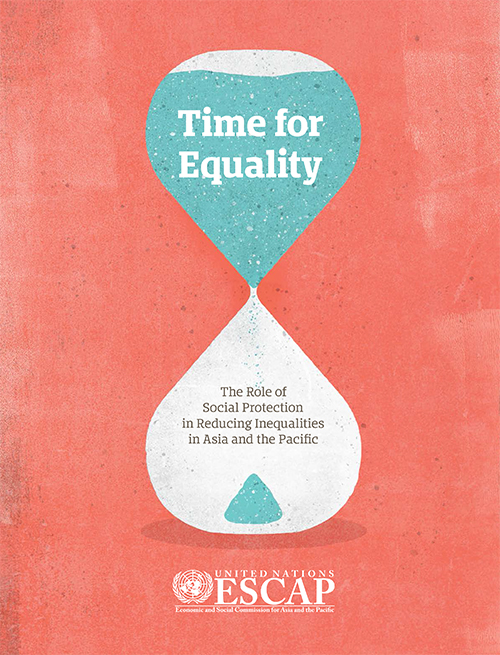
In an effort to expand the evidence base in the area of redistributive policies, the publication illustrates that social protection is an effective instrument to reduce inequalities, and by so doing, contributes to the integration of the economic, social and environmental dimensions of sustainable development. The report can be accessed here.
ESCAP's Work
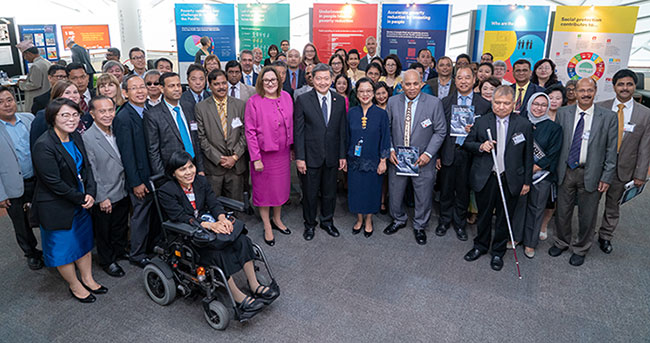
Members and associate members of ESCAP have repeatedly underscored the urgency of moving toward universal social protection coverage by adopting resolution 74/11 (2018) on “Strengthening regional cooperation to tackle inequality in all its forms in Asia and the Pacific”, calling upon member States to invest in social protection systems that promote access to essential services, resources and decent jobs, to end poverty and reduce inequalities; as well as resolution 67/8 (2011) on “Strengthening social protection systems in Asia and the Pacific”, calling upon member States to invest in building social protection systems to form the basis of a ‘social protection floor’.
The fifth session of the ESCAP Committee on Social Development, held 29-30 November 2018, also recommended the strengthening of regional cooperation on social protection, and encouraged ESCAP, in coordination with relevant United Nations agencies, to explore and develop a modality for regional cooperation to support member States in this regard.
Universal social protection and the Social Protection Floors (SPF) Initiative provide the guiding frameworks for ESCAP’s work in the area of social protection. ESCAP supports national and regional efforts by functioning as a knowledge platform for policymakers and stakeholders, and providing technical support to member States to build and strengthen inclusive social protection systems.
Tools and Methodologies
Social Protection and the SDGs

ESCAP has developed various tools on social protection and the SDGs, including a policy guide, a video and an interactive infographic (coming soon). The report Time for Equality highlighted the linkage between social protection and the three dimensions of sustainable development.
The Social Protection Toolbox

The Social Protection Toolbox is ESCAP’s online platform to support countries in the Asia-Pacific region to build inclusive social protection systems. The Toolbox contains capacity- and knowledge building tools, such as basic e-learning guides, videos, infographics, fact sheets, games, in-depth studies, an interactive tool to identify national coverage gaps, as well as over 100 good practices for inspiration and cross-country learning.
If you want to receive updates from the Social Protection Toolbox, please contact us on: admin@socialprotection-toolbox.org
Policy guides on inclusive social protection
The ESCAP policy guides on inclusive social protection include:
Why We Need Social Protection explaining the basic principles of social protection and the role it can play in achieving the sustainable development goals.
How to Design Inclusive Social Protection Systems explaining how to design inclusive and robust social protection systems, focusing on tax-financed income security. The guide discusses key policy choices such as universal vs. targeted schemes and how conditions attached to social protection transfers can have negative impacts at the household level.
How to Implement Inclusive Social Protection Systems explaining how to implement inclusive social protection schemes. The guide outlines the administrative processes, organizational policies and systems required to implement tax-financed social protection.

How to Finance Inclusive Social Protection Systems examining ways to finance social protection, with a focus on tax-financed social security schemes. The guide outlines options for increasing investment in social protection through general government revenues, and briefly discusses social insurance schemes financed through contributions.
The policy guides are also available in Russian
A fifth policy guide on social protection for persons with disabilities is coming soon.
What is the Impact of Social Protection?
ESCAP’s social protection simulation tool is an interactive platform for users who want to explore the impacts and benefits of providing comprehensive and inclusive social protection systems. It estimates the impact of introducing social protection programmes on poverty and inequality and computes the relative cost of simulated programme(s), providing different illustrative options to expand fiscal space for social protection. Users are able to delve into different policy options where various social protection programmes are introduced in a country, by setting parameters related to eligibility criteria, coverage levels, and transfer values. To further explore alternative scenarios, the user can also modify assumptions about administrative programme costs or to change economy-wide parameters, such as the expected real annual growth rate.
Who are the Furthest Behind?
This tool helps policy makers identify the blend of circumstances which are most likely to leave population groups furthest behind in access to key development indicators. It helps policymakers move beyond overall averages to identify population groups with the lowest - and highest - access to a number of basic services and opportunities. The methodology uses a statistical algorithm that splits the population into groups with significantly different access levels, based on a combination of shared circumstances that households or individuals have in common.