Overview
Social

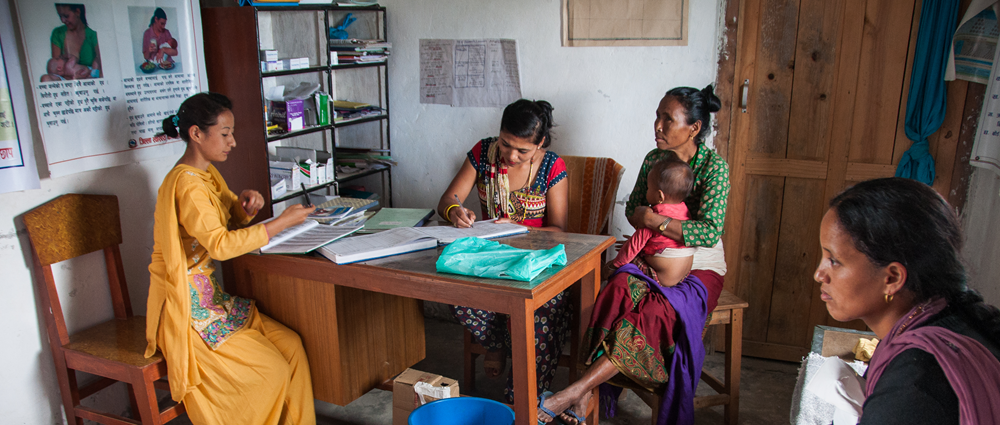
Social protection is first and foremost a human right. Human rights instruments, including the Universal Declaration of Human Rights (1948) and the International Covenant on Economic, Social and Cultural Rights (1966), firmly anchor social protection as a right that States are obligated to guarantee and a right to be enjoyed by all without discrimination. These normative instruments recognize the critical role social protection plays in ensuring human dignity and well-being. They also recognize the role of social protection in enabling other human rights, including the right to health, education and development.
Social protection schemes provide cash or in-kind support for people facing social or economic risks. It provides a solid foundation for the realization of the economic, social and environmental dimensions of the 2030 Agenda for Sustainable Development. Social protection is therefore explicitly mentioned in four Sustainable Development Goals, related to ending poverty (SDG 1); ensuring healthy lives (SDG 3); achieving gender equality (SDG 5); and reducing inequalities (SDG 10).
Most prominently, Goal 1 on ending poverty includes target 1.3 to “implement nationally appropriate social protection systems and measures for all, including floors, and by 2030 achieve substantial coverage of the poor and the vulnerable.”
Despite remarkable economic and social progress in the Asia-Pacific, critical social protection coverage gaps persist. For instance,
- About half of the region’s population has no social protection coverage.
- Only a handful of countries have comprehensive social protection systems with relatively broad coverage.
- Most poverty-targeted schemes fail to reach the poorest families.
- Maternity, unemployment, sickness and disability benefits, mostly covered by contributory schemes, remain the preserve of workers with a formal job.
- While the majority of older persons receive a pension, significant gaps remain and benefits are often insufficient to cover basic needs.
- The lack of access to affordable health care is leaving individuals without treatment and households vulnerable to falling back into poverty.
- Effective social protection requires a significant but affordable increase of public spending.
Universality is key to effectively reaching those who need support, when they need it. Achieving it requires a mix of contributory and non-contributory benefit schemes in which coverage is addressed through a “horizontal” and a “vertical” dimension. The horizontal dimension requires everyone to have a minimum level of protection regardless of their previous income or employment status: a social protection floor. The vertical dimension relates to the progressive move to higher levels of protection, primarily through contributory schemes. Universal systems along the life course are better able to nurture social protection as part of a national social contract between the State and its people. This social contract is required to scale up investment in a sustainable way.
Technology can also facilitate the identification and registration of those contributing to and benefiting from social protection schemes. Linking social protection databases to national identification systems reduces the risks of fraud and duplication.
On average, public spending on social protection in the Asia-Pacific region (excluding health) is 7 per cent of GDP, which is lower than the global average of 11 per cent, less than half the level in Europe (17.7 per cent). There are, however, notable examples of progress in recent decades. One is China, which increased expenditure levels from 3.2 per cent of GDP in 1995 to 7.2 per cent in 2017.
Many countries in the region continue to spend less than two per cent of GDP on social protection. Low expenditure on social protection sometimes correlates with low levels of general government revenue. Increasing government revenue can therefore be instrumental to creating the fiscal space required to expand coverage.
Investment in basic social protection would have an immediate impact on reducing poverty, inequality and purchasing power disparities. Simulations conducted by ESCAP in 13 countries show that if governments offered universal coverage for child benefits, disability benefits and old-age pensions at a basic benefit level, poverty rates would significantly drop across the region. The proportion of recipient households living in poverty would fall by up to 18 percentage points.
This investment is within reach for most countries in the region. Independent cost estimations from ESCAP, ILO and ADB, are all within the range of 2 to 6.1 per cent of GDP. The size of the investment required varies, depending on the benefit level chosen, the schemes covered and the demographic and economic situation of each country. Yet it is an affordable investment for countries of all income levels.
The COVID-19 crisis has resulted in a significant response from countries. The social protection response to the COVID-19 pandemic is unprecedented. Countries have recognized, and sought to fill, significant coverage gaps in their existing social protection systems. In many cases, responses have — for the first time — represented a comprehensive approach, with the aim to reach the whole population through an overlapping package of contributory and noncontributory schemes. Expenditures for these schemes have been significant compared to social protection expenditures in normal times. However, generally, countries with the most effective responses to the pandemic are those that had robust systems in place before the crisis. In the end, the ongoing pandemic has created an opportunity to strengthen social protection systems for the future.
Social Outlook for Asia and the Pacific
 |
The most recent report, The Protection We Want: Social Outlook for Asia and the Pacific, was launched in 2020 on the sidelines of the fifth Regional Conversation Series on Building Back Better. It finds that social protection systems in the region are riddled with gaps. To assist policymakers in their efforts to broaden social protection coverage, the report provides evidence that investing in basic social protection would have an immediate impact on poverty, inequality and purchasing power, while being within financial reach for most countries.
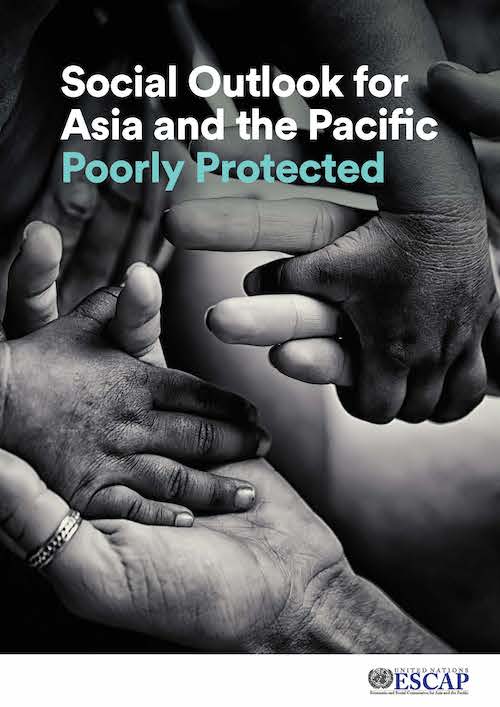 |
Preceding this, ESCAP’s flagship publication Social Outlook for Asia and the Pacific: Poorly Protected, launched at the fifth Session of the Committee on Social Development on 28 November 2018, calls on countries across Asia and the Pacific to beef up their investment in people, pointing out how greater investment in social protection can be a game changer for ending poverty.
The report shows that increasing the region’s investment in social protection to the global average could help eradicate extreme poverty in countries such as Bangladesh, India, Nepal and the Philippines. It would lift 52 million people out of extreme poverty and 328 million people out of moderate poverty. Such an investment would also lead to an increase in GDP growth and reduced income inequalities. The study cites examples of low- and lower-middle income countries that have been successful first movers in investing well in people, including Bhutan, Mongolia, Thailand and Viet Nam.
Time for Equality: the role of social protection in reducing inequalities in Asia and the Pacific
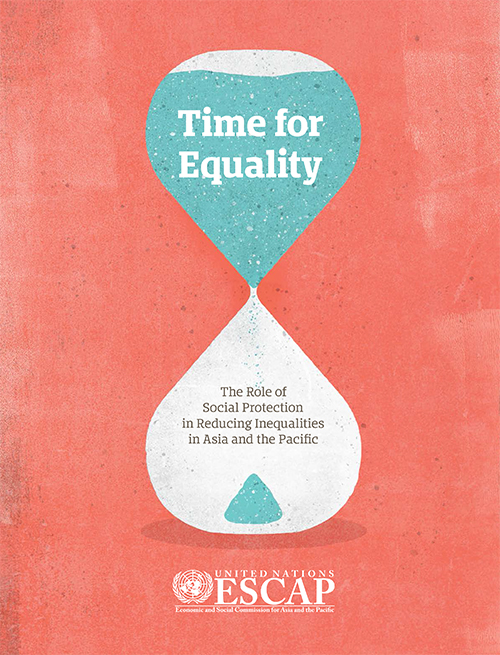 |
In an effort to expand the evidence base in the area of redistributive policies, the publication illustrates that social protection is an effective instrument to reduce inequalities, and by so doing, contributes to the integration of the economic, social and environmental dimensions of sustainable development. The report can be accessed here.
ESCAP's Work
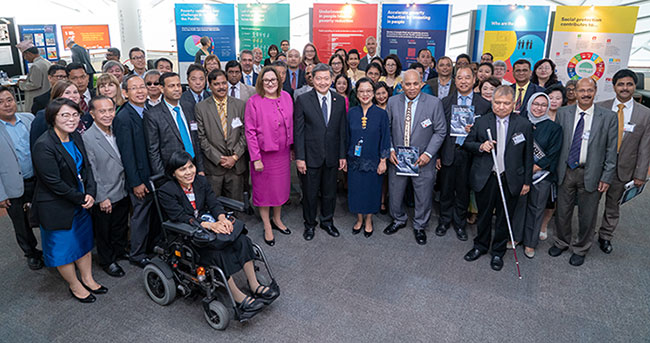
Against the backdrop of persisting poverty and widening inequalities, ESCAP supports national and regional efforts by functioning as a knowledge platform for social protection, including through its Social Protection Toolbox. ESCAP advocates for inclusive social protection along the Social Protection Floor and works to strengthen the capacity of policymakers in the Asia-Pacific region to design, implement and finance inclusive social protection as a tool for achieving the 2030 Agenda.
The sixth session of the ESCAP Committee on Social Development, held 20-21 October 2020, endorsed the Action Plan to Strengthen Regional Cooperation on Social Protection in Asia and the Pacific. The action plan serves as a regional shared vision, strategy and platform to promote partnership, peer learning and identify needs for technical assistance.
Members and associate members of ESCAP have repeatedly underscored the urgency of moving toward universal social protection coverage by adopting resolution 74/11 (2018) on “Strengthening regional cooperation to tackle inequality in all its forms in Asia and the Pacific”, calling upon member States to invest in social protection systems that promote access to essential services, resources and decent jobs, to end poverty and reduce inequalities; as well as resolution 67/8 (2011) on “Strengthening social protection systems in Asia and the Pacific,” calling upon member States to invest in building social protection systems to form the basis of a "social protection floor."
Universal social protection and the Social Protection Floors (SPF) Initiative provide the guiding frameworks for ESCAP’s work in the area of social protection. Through the Regional Action Plan, ESCAP aims to support national and regional efforts by to enhance the capacity of member States to build and strengthen inclusive social protection systems.
Tools and Methodologies
ESCAP has developed online tools to enhance capacity on social protection through:
- The Social Protection Toolbox that shares resources and good practices on social protection.
- The Social Protection Simulation Tool to simulate the impacts of social protection.
- The Database on Identifying Those Left Furthest Behind to assess gaps in access to opportunities.
Policy guides on inclusive social protection
The ESCAP policy guides on inclusive social protection include:
Why We Need Social Protection explaining the basic principles of social protection and the role it can play in achieving the sustainable development goals.
How to Design Inclusive Social Protection Systems explaining how to design inclusive and robust social protection systems, focusing on tax-financed income security. The guide discusses key policy choices such as universal vs. targeted schemes and how conditions attached to social protection transfers can have negative impacts at the household level.
How to Implement Inclusive Social Protection Systems explaining how to implement inclusive social protection schemes. The guide outlines the administrative processes, organizational policies and systems required to implement tax-financed social protection.

How to Finance Inclusive Social Protection Systems examining ways to finance social protection, with a focus on tax-financed social security schemes. The guide outlines options for increasing investment in social protection through general government revenues, and briefly discusses social insurance schemes financed through contributions.
The policy guides are also available in Russian
A fifth policy guide on social protection for persons with disabilities is coming soon.
What is the Impact of Social Protection?
ESCAP’s social protection simulation tool is an interactive platform for users who want to explore the impacts and benefits of providing comprehensive and inclusive social protection systems. It estimates the impact of introducing social protection programmes on poverty and inequality and computes the relative cost of simulated programme(s), providing different illustrative options to expand fiscal space for social protection. Users are able to delve into different policy options where various social protection programmes are introduced in a country, by setting parameters related to eligibility criteria, coverage levels, and transfer values. To further explore alternative scenarios, the user can also modify assumptions about administrative programme costs or to change economy-wide parameters, such as the expected real annual growth rate.
Who are the Furthest Behind?
This tool helps policy makers identify the blend of circumstances which are most likely to leave population groups furthest behind in access to key development indicators. It helps policymakers move beyond overall averages to identify population groups with the lowest - and highest - access to a number of basic services and opportunities. The methodology uses a statistical algorithm that splits the population into groups with significantly different access levels, based on a combination of shared circumstances that households or individuals have in common.